
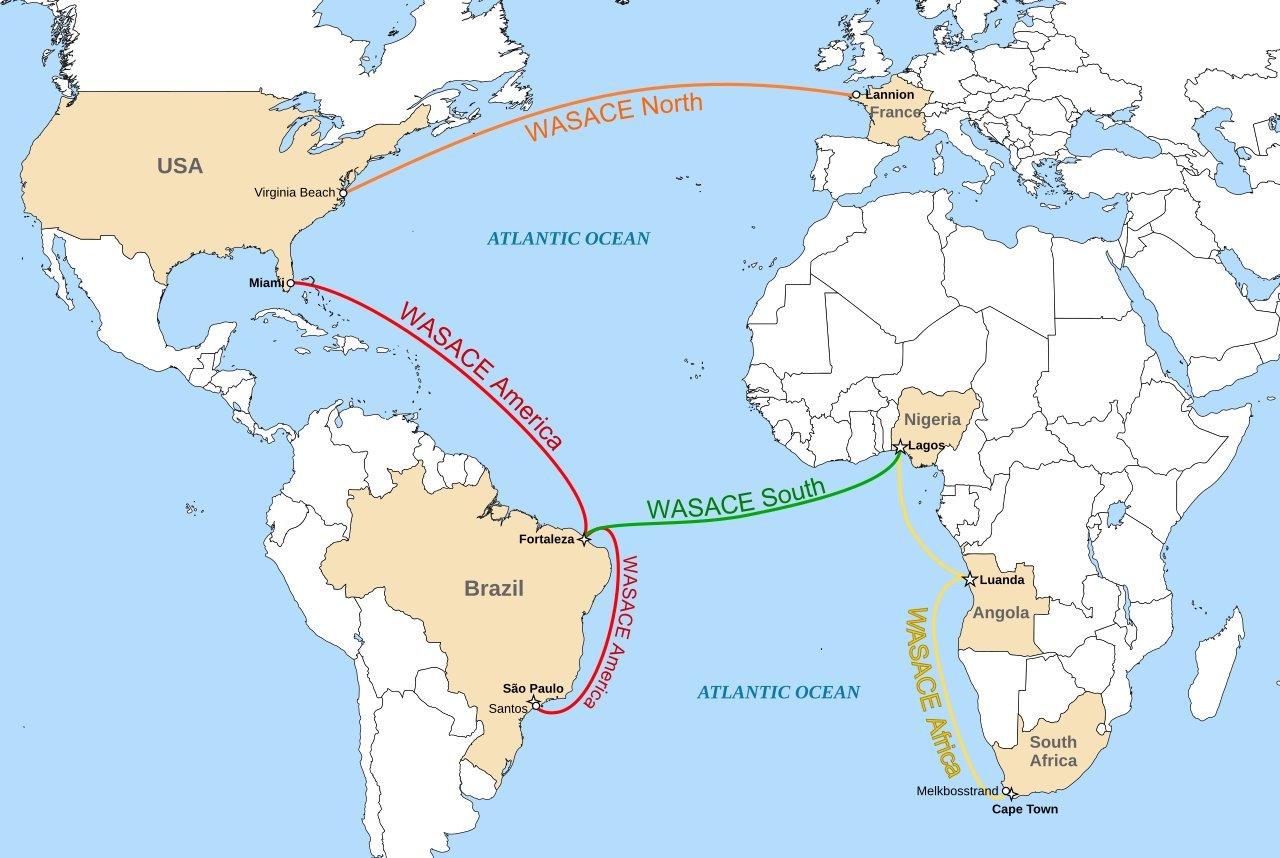
Submarine cables, fibre-optic lines laid across the ocean floor, carry the vast majority of international internet traffic. When you open a website hosted in Europe or the United States from Lagos, Accra or Mombasa, your data almost certainly travels through one of them. Africa’s dependence on a limited number of cables explains why a single incident at sea can disrupt internet across several countries.
How undersea cables work
A submarine cable contains strands of optical fibre that carry data as pulses of light. Around the fibres are layers of protection: steel wires, copper for powering signal-boosting repeaters, and insulation. In deep water, cables can be about as thick as a garden hose; near shore they are heavily armoured against anchors and fishing gear. Cables come ashore at landing stations, which connect them to national fibre networks.
Africa’s cable network
The continent has gone from a handful of cables in the early 2000s to dozens today. Long-standing systems along the west and east coasts have been joined by large new ones, such as 2Africa, built by a consortium including Meta, which circles the continent, and Google’s Equiano along the west coast to South Africa. More cables mean more capacity, lower wholesale bandwidth prices and alternative routes when something breaks.
Why cables break
- Ship anchors and fishing are the most common causes worldwide
- Natural events such as underwater landslides, turbidity currents and earthquakes
- Equipment failure at repeaters or landing stations
In 2024, damage to several cables off West Africa and, separately, off East Africa caused major disruptions in multiple countries at once, highlighting how many systems follow similar routes.
Why one cut can affect many countries
- Several cables often run along the same coastal path, so one event can damage more than one
- Some countries rely on just one or two cables
- Landlocked countries depend on neighbours’ landing stations and cross-border fibre
- Operators may not have bought backup capacity on other cables
How repairs work
Specialised repair ships locate the fault, lift the cable ends to the surface, splice in a new section and lower it back. Repairs can take days to weeks, depending on ship availability, depth, weather and permits. Africa has relatively few repair ships, which can extend outages.
Making connectivity more resilient
- More cables on diverse routes, including new landing points
- Operators buying capacity on multiple cables to reroute traffic
- Terrestrial fibre linking countries so traffic can reach other landing stations
- Local data centres and content caches, so popular services keep working when international links are cut
- Satellite backup for critical services; see Satellite Internet in Africa
What businesses can do
- Use two internet providers that rely on different upstream routes
- Host critical systems locally or in-region where possible
- Keep offline procedures for payments and operations
- Back up data in more than one location; see our guide to backups and resilience
For the complete picture, read Internet Connectivity in Africa.